How to Order a Custom Foam Insert for Your Hard Case
The short answer
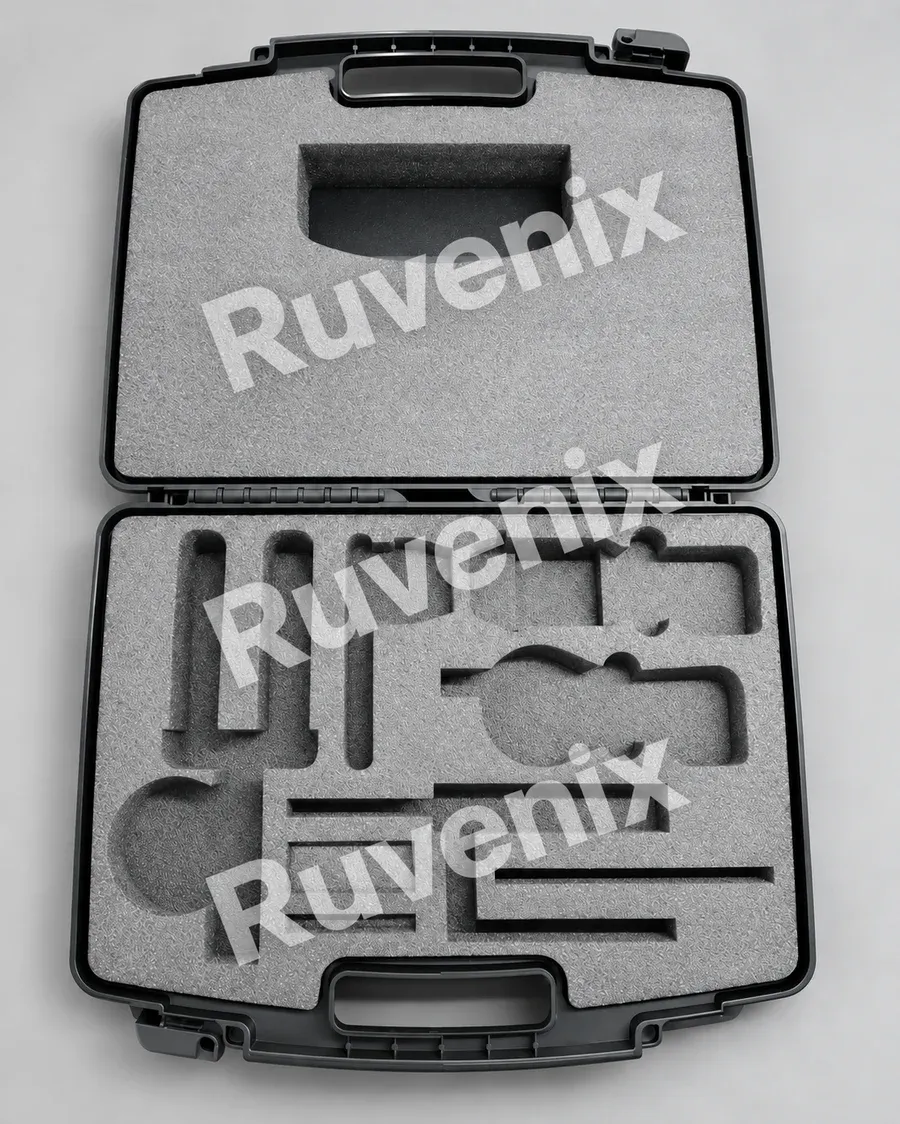
A foam insert is cut to fit your equipment, so the equipment stays in place inside the case instead of moving around in transit. Send us the case model (or the internal size you need) and drawings of your equipment, and the foam is cut to that shape. This applies whether you call it a toolbox, a hard case, a waterproof case or an equipment case: the buying mistake is always the same — ordering foam by the case size alone, without the equipment's shape and depth.
Step 1 — Decide what the foam has to hold
Start with the equipment, not the case. List each item that goes in the case, how it sits when it travels, and anything that sticks out — handles, cables, lenses, antennas. Items that are stacked or laid on top of each other need foam that holds each layer, so say so in your inquiry rather than assuming one flat layer will do.
Step 2 — Choose the foam material
Three foam materials are available: EVA, EPE pearl foam, and regular sponge. Which one fits best depends on your equipment and how it travels, so tell us what the equipment is and how the case will be used when you inquire, and we will confirm the material for your order. Do not order on material name alone — the same foam cut to the wrong shape protects nothing.
Step 3 — Send drawings of your equipment
Foam is cut to your equipment, so we need your drawings to cut it. Send the dimensions of each item and how the items are laid out inside the case. The inquiry form has no file upload, so please email your drawings to a@ruvenixcases.com after submitting your inquiry. If you have a layout sketch showing where each item sits, send that too — it is the fastest way to get an accurate answer.
Step 4 — Leave room for the foam in the case
Foam takes space, and it takes depth most of all. Measure your equipment inside the foam, not bare — and check the internal height of the case separately, because that is the number buyers most often forget. These are five of our existing-mould models, with their real dimensions:
| Model | External (mm) | Internal (mm) | Waterproof |
|---|---|---|---|
| DY011# | 360 × 270 × 90 | 347 × 220 × 82 | Waterproof |
| DY705# | 425 × 320 × 115 | 420 × 265 × 112 | Waterproof |
| DY706# | 450 × 330 × 130 | 445 × 285 × 124 | Waterproof |
| DY007# | 470 × 360 × 148 | 465 × 310 × 140 | Waterproof |
| DY8810 | 517 × 430 × 150 | 483 × 363 × 140 | Waterproof |
(Model names link to their product pages.) Pick the smallest model whose internal length, width AND height are all larger than your equipment inside its foam — see Guide 01 for how to measure by internal dimensions. A deeper version of the DY8810 is available on request; please mention your required internal height in your inquiry.
Step 5 — If no stock size fits
Other sizes can be made to order on request. All 81 models on this site are available from existing moulds; anything outside those sizes is custom. When you inquire, send your required internal dimensions and your equipment drawings — that is the fastest way to get an accurate answer.
Ready to get a quote?
Send an inquiry with your model, quantity and required internal dimensions. Samples and small trial orders are available. If you have drawings, please email them to a@ruvenixcases.com after submitting. Phone is optional — email is enough.